Redefining the DXP: From Execution to Orchestration

At Ibexa Summit 2026, we shared an important evolution of our product strategy.
Not a sudden shift, and not a break with what already works, but the next logical step in a journey we started several years ago.
This article is a recap of that journey: where we come from, what we announced, and how we see the future of digital experience platforms taking shape. Enjoy your reading!
1. From Standalone Products to a Composable DXP
For a long time, digital experience platforms followed a familiar promise: one platform, one system, one way of working… one-size-fits-all approach. At Ibexa, we deliberately choose a different path.
We believe that great digital experiences are not built by a single monolithic tool, but by great products, each designed to excel at a specific job. Customer data, product information, content, campaigns, activation — each of these domains deserves deep focus and continuous innovation.
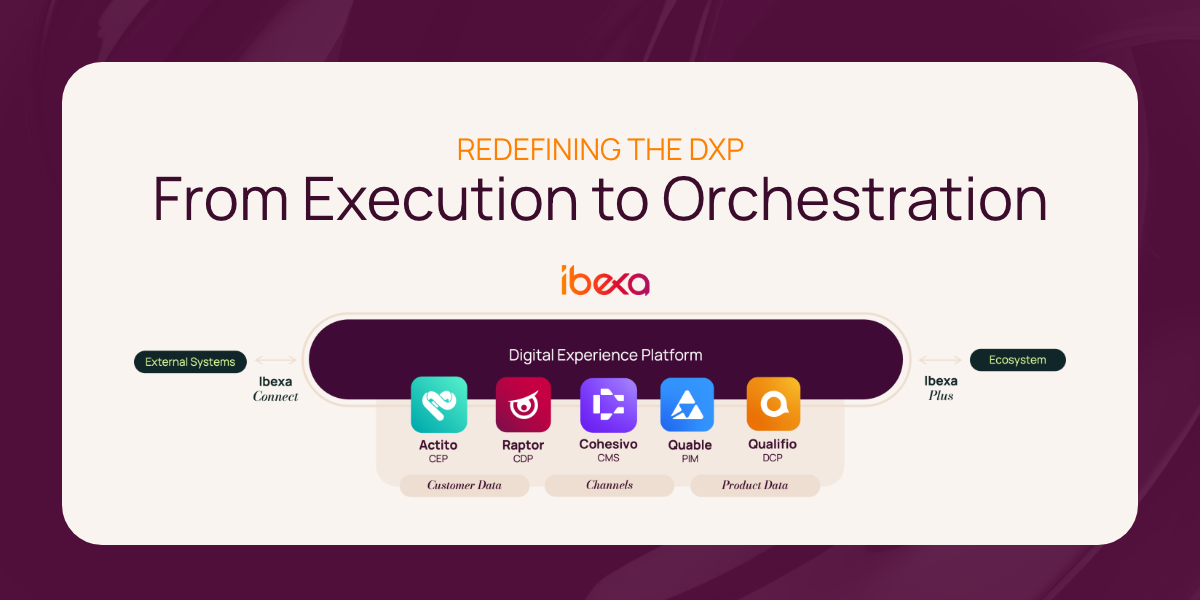
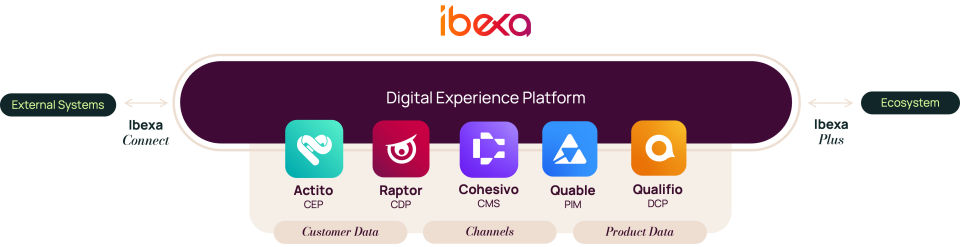
Instead of forcing everything into one system, we invest in best-in-class products beyond Ibexa DXP: Actito CEP, Raptor CDP, Qualifio DCP, and Quable PIM. The challenge was never about choosing between them. The real challenge was making them work together in a way that feels coherent, reliable, and usable for marketing teams.
Over the past years, our focus has been on building a truly composable Digital Experience Platform. Not composability as an abstract architectural concept, but composability as a concrete experience: shared foundations, common execution layer across products, consistent access, and a growing sense that these tools belong to the same ecosystem.
As the platform matured, two elements became increasingly critical: how products connect, and how people move between them.
Premium integrations: turning products into real outcomes
A critical milestone in this journey involves developing premium integrations between products. From a customer perspective, integrations are not about APIs or connectors; they are about time-to-value and reduced complexity.
Premium integrations remove friction from real-life use cases. Product data can flow naturally into content experiences, audiences can be activated without manual stitching, and signals can travel across systems without constant reconciliation. This is what makes the “suite effect” tangible, not in theory, but in everyday usage.
That is why we continue to invest heavily in premium integrations beyond the 6 integrations already available. These are a core part of how our DXP creates value, by reducing manual coordination and allowing teams to focus on outcomes instead of plumbing.
2 Premium integrations have been announced during the Summit and will be shipped in the coming weeks:
Ibexa DXP <> Quable PIM integration: full sync in term of products so you can use them where you want across the DXP – for example the PageBuilder.
Ibexa DXP <> Raptor CDP: website recommendations provided by Raptor are now integrated in the PageBuilder with new blocks. Drag and drop them and it’s done!
An integration inside the Rich Text Editor is also coming soon.
UX and UI harmonization: making the platform usable at scale
As products become more connected, another challenge emerges: usability. A composable platform only works if teams can move naturally from one product to another, without friction and without having to relearn everything each time.
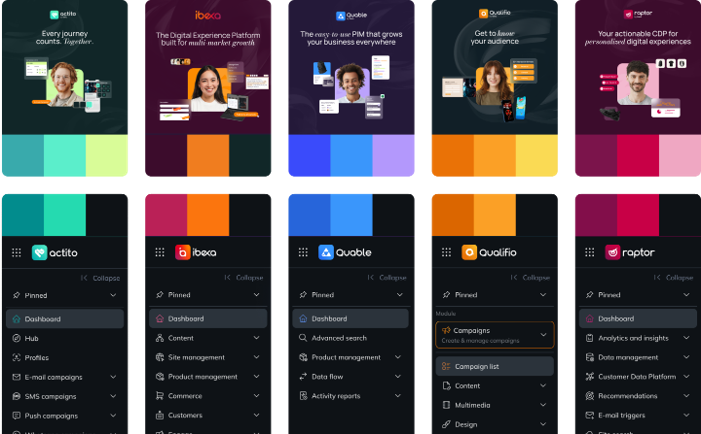
This is why UX and UI harmonization are strategic initiatives for us. The goal is not to make all products look identical, but to make them feel coherent and easier to use. Common interaction patterns, consistent navigation, and shared concepts help teams adopt the platform faster and use it with confidence.
Harmonisation is not a cosmetic exercise. It is a key driver of adoption. It is what turns a collection of powerful tools into a platform that teams can actually use every day. We are working on this topic, in parallel to SSO, to provide a smooth experience for every marketers. We have worked hard to make ‘One Experience’ a reality.
A clearer evolution of our CMS
Content remains a central pillar of digital experience. As our platform evolved, it became clear that our CMS also needed a clearer position within this composable landscape.
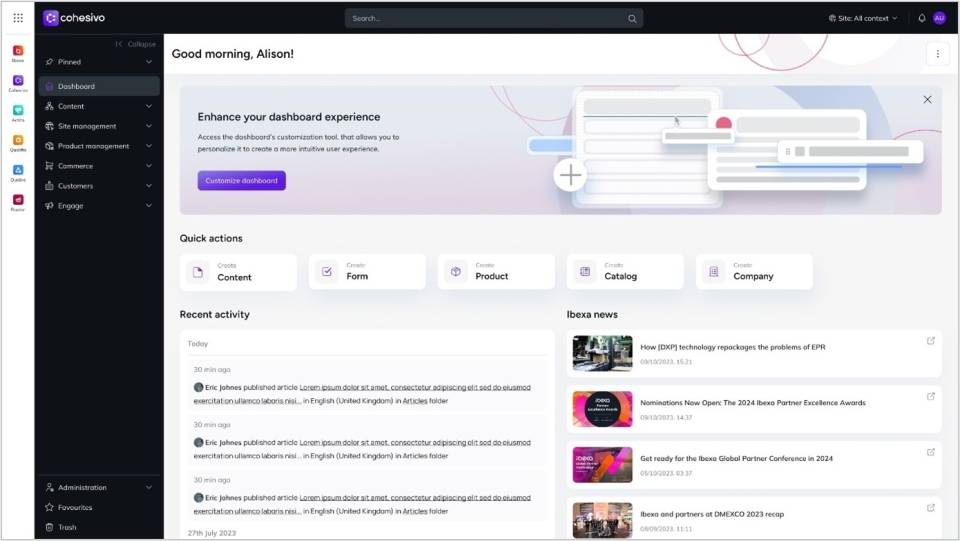
That is why we are now introducing Cohesivo CMS.
Cohesivo is not a second CMS, and it is not a restart. It is the next step in the evolution of the Ibexa DXP CMS, built on the same foundations, the same heritage, and the same core use cases. It brings a clearer identity, a SaaS-ready delivery model (on top of PaaS/OnPrem), and a modern base for future innovation, including AI-powered content workflows.
Importantly, the SaaS version of Cohesivo will be based on the same tech foundation as the PaaS/OnPrem versions. This means you can start quickly with SaaS and seamlessly move to PaaS if you need more flexibility – with no additional effort. This is our promise.
At the same time, it continues to support existing scenarios - including ecommerce - while strengthening the execution layer of the platform. This evolution is strategic: it allows us to keep improving execution while preparing the platform for orchestration. Our direction is clear, we want to provide the best CMS on the market.
Execution, reinforced - not replaced
Today, our Digital Experience Platform covers all core execution capabilities: customer data, product data, content, and channels. And we continue to invest across the entire portfolio.
This point matters. Orchestration does not replace execution. It builds on top of it. Strong products, premium integrations, and a harmonised experience are not optional. They are the foundation that makes everything else possible.
2. Introducing the Orchestration Engine: Turning Execution into Outcomes
Over the past few years, marketing teams have built incredibly powerful execution stacks. Content is produced faster, campaigns are launched across more channels, and data is available everywhere. From the outside, everything looks optimized.
And yet, many teams share the same feeling: despite all this power, decisions are harder to make.
Marketers are busy executing, reacting, adjusting. Signals come from every direction. Priorities change quickly. Coordination between tools often relies on manual work, meetings, or last-minute trade-offs. AI was expected to help simplify this complexity, but in many cases it added another layer of noise: more suggestions, more alerts, more local optimizations — without a global view.
At this point, the problem is no longer execution.
The real bottleneck is coordination.
Why execution alone is no longer enough
Most marketing stacks are now best-in-class by design. Each product does its job well. But decisions are still made in silos, tool by tool, team by team. What is missing is not another feature, another channel, or another dashboard.
What is missing is a way to decide consistently across the entire stack, based on shared context and clear business intent.
This is where orchestration becomes critical.
Orchestration is not about doing more.
It is about deciding better.
A new layer above the DXP
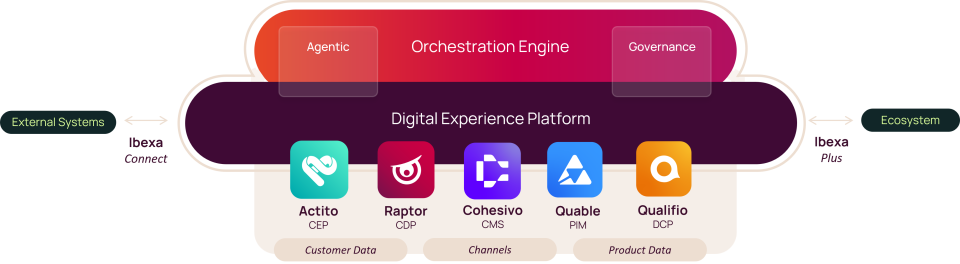
This is why we introduced the Ibexa Orchestration Engine.
The Orchestration Engine is a new layer that sits on top of our composable DXP. Its role is not to replace existing products, and not to centralise execution. Products continue to do what they do best: manage data, create content, activate channels.
The orchestration engine focuses on something else entirely: turning intent into coordinated execution.
Instead of asking teams to manually connect tools and workflows, it provides a shared decision layer that understands goals, evaluates context, and coordinates actions across systems. In other words, execution stays distributed, but decisions become aligned.
This is a strategic shift for the platform. Not away from execution, but beyond it.
From signals to prioritised outcomes
From a marketer’s perspective, orchestration answers a very concrete question: what should I focus on now?
Signals come from many places: customer behavior, campaign performance, product data, content engagement. Taken individually, they are useful. Taken together, they can be overwhelming. Orchestration brings structure to this complexity by turning signals into priorities, and priorities into decisions.
Instead of reacting to everything, teams can focus on what matters most. Instead of optimizing locally, they can act with a global view. This is where orchestration starts creating value, not as a concept, but as a daily working model.
Assistants and agents: from intent to execution
To make orchestration usable, roles must be clear.
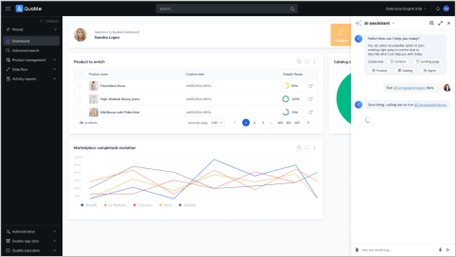
Assistants are how humans interact with orchestration. They capture intent, ask the right questions, and guide marketers through decisions. They make orchestration accessible, without forcing teams to change how they work. We will provide Assistants in every Ibexa product in the coming months.
Agents are what turn decisions into action. They are specialised executors, each responsible for a specific role, operating within defined boundaries. One agent can already bring immediate value. Multiple agents, working together, make coordinated execution possible across products and systems.
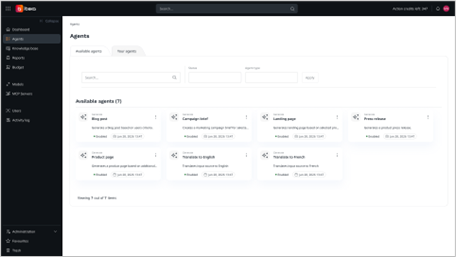
This is not about autonomous AI running unchecked. It is about structured execution, guided by intent and context, and coordinated across the stack. We will provide 2 types of agents: out-of-the-box agents, ready and simple to use ; and custom agentsto leverage the power of our community.
Orchestration only works with trust
There is one condition without which orchestration cannot succeed: trust.
At enterprise scale, AI-driven execution must be observable, controllable, and accountable. Governance is not something you add later, once things get risky. It must be designed from the start.
That means clear visibility into what happens, defined approval mechanisms, explicit constraints, and human responsibility at every step. AI can assist and execute, but accountability always remains human.
That’s why we’re building governance capabilities like: traceability, audit logs, approvals, and quality evaluation - including LLM judge mechanisms.
This is not only a product principle. It is also a commitment. That is why we are introducing Ibexa Signature, to formalize our approach to responsible, transparent, and enterprise-grade AI-powered marketing.
A shift toward outcomes, not more automation
The introduction of the Orchestration Engine marks an important moment for the Ibexa platform.
We are not adding more execution.
We are not replacing existing products.
We are adding a coordination layer that changes how value is created.
Execution creates activity.
Orchestration creates outcomes.
This is the direction we are taking, and it is how we see the future of digital experience platforms evolving.
What about timing?
We also want to be very clear about what comes next.
- Premium integrations Ibexa<>Quable and Ibexa <>Raptor
Target availability: Q1 2026 - Cohesivo CMS (SaaS-ready)
Target availability: Summer 2026 - UX and UI harmonization across products
Progressive rollout starting Summer 2026 - Orchestration Engine (early adopters)
Summer 2026
We will continue to share updates as these milestones approach, this is our engagement: to share in full transparency our progress, success but also failures with our great community. We want to continue to involve more our partners and customers in product definition, as this is key to build great products that Customers love!
From execution to orchestration - governed by design
Our direction is clear.
Execution remains essential, and we keep investing in every product heavily.
Orchestration is how value is created across products and systems.
Governance is what makes AI adoptable at enterprise scale.
This is how Ibexa moves from execution to orchestration.
If you want to continue the conversation, we’ll go deeper in upcoming product sessions, roadmap updates, and technical briefings.